Machine tending
Long cycles on several machines give one mobile cobot the time to load them in turn, even as the part mix changes.
Cobot on an autonomous mobile robot
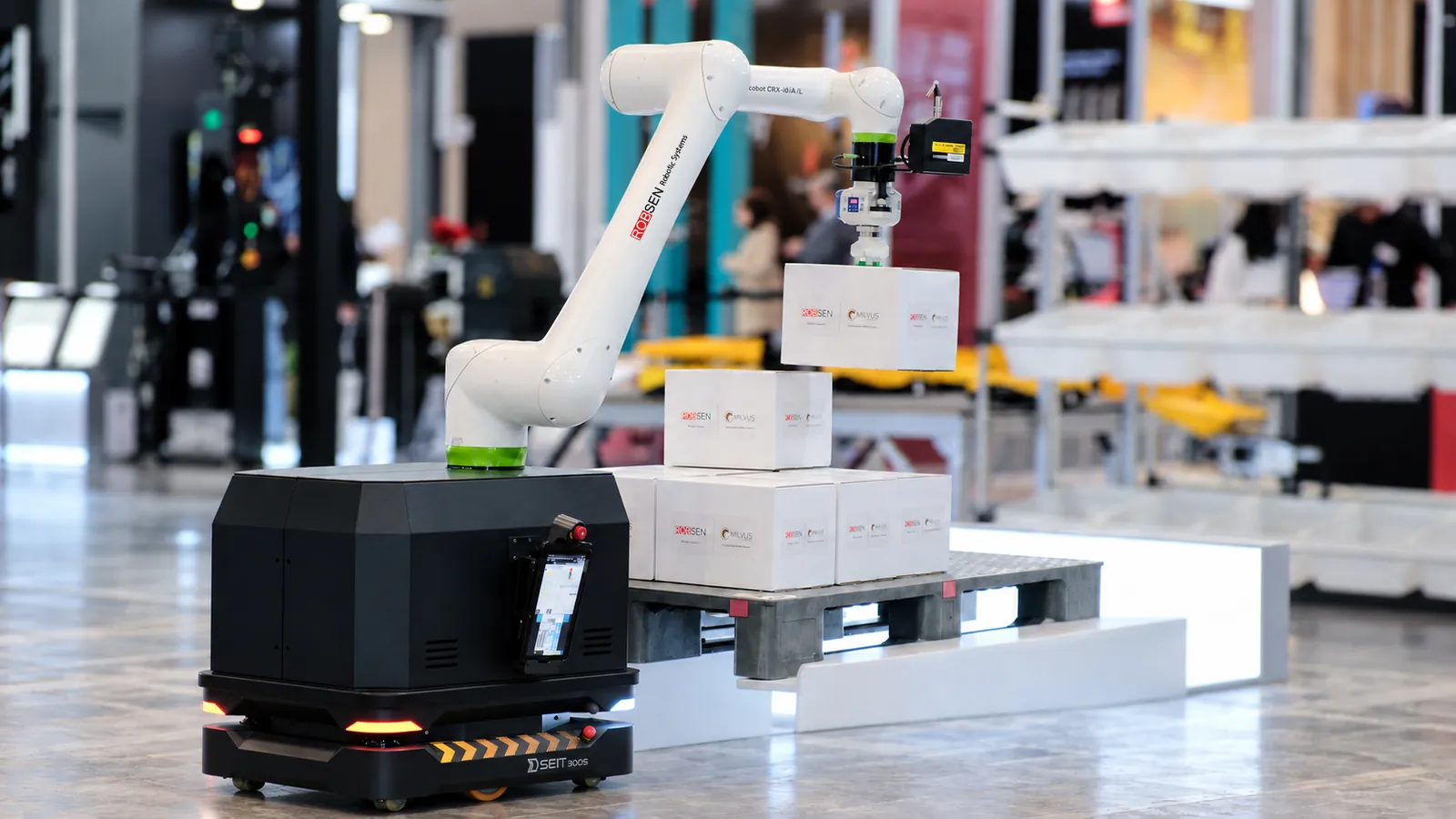
One robot. Multiple machines. No fixed layout. A FANUC CRX cobot on a Milvus AMR drives to the machine that needs it, tends it, and moves on.
One platform, three applications
Each IROCUBE Mobile is set up for one job. What they share: long cycles, a need for spatial flexibility, and a robot that moves between stations.
Long cycles on several machines give one mobile cobot the time to load them in turn, even as the part mix changes.
Pick from several stations and build the right pallet, by destination, order or customer.
Deliver kits to workstations, move parts between lines, take samples to quality control.
Simplified illustration: three IROCUBE Mobiles, each set up for one job. Counters are examples.
Read a Mobile model name
Drag to turn it. The dashed circle is the cobot's reach.
A Milvus Robotics SEIT. It finds its own way with LiDAR, no floor tape. The number is the SEIT model.
A FANUC CRX, safe to work next to people. The number is its payload in kilograms, L means long reach. A bigger cobot needs a bigger base.
Technology partners
Milvus Robotics builds the AMR. FANUC builds the cobot. Robsen Robotics turns the two into one machine and stays your contact for all of it. Select a + to meet each partner.
IROCUBE Mobile 03-10L: a FANUC CRX-10iA/L on a Milvus SEIT300S. Drag to turn it.
How the three fit together
Each part comes from a company that has specialized in it for years. You deal with one team: Robsen Robotics, a FANUC Authorized System Integrator, is responsible for the whole IROCUBE Mobile.
01 The AMR · SEIT series
Milvus Robotics designs and builds autonomous mobile robots for factories and warehouses. Founded in 2011 in Ankara, Türkiye, with an office in Atlanta, USA, it has robots at work in more than 30 countries, coordinated by its own Milvus Fleet Manager software.
The SEIT is the base that carries the cobot from station to station. It navigates by LiDAR on a map of your plant, with no tape or markers on the floor, plans its route around people and obstacles, and docks within a few millimeters.
| SEIT model | Payload | Carries |
|---|---|---|
| SEIT300S | 350 kg | CRX-5iA to CRX-10iA/L |
| SEIT500 | 800 kg | up to CRX-20iA/L |
| SEIT1500S | 1,800 kg | up to CRX-30iA |
02 The cobot · CRX series
FANUC, headquartered at the foot of Mount Fuji in Japan, builds CNC systems, industrial robots and ROBODRILL machining centers. Its roots go back to Japan's first NC system in 1956. It shipped its one millionth robot in 2023, and its "Service First" policy promises maintenance for as long as customers use its products.
The CRX is the arm that tends the machine, builds the pallet or sets down the parts. FANUC calls it mobile robot-ready.
| CRX model | Payload | Reach |
|---|---|---|
| CRX-5iA | 5 kg | 994 mm |
| CRX-10iA | 10 kg | 1,249 mm |
| CRX-10iA/L | 10 kg | 1,418 mm |
| CRX-20iA/L | 20 kg | 1,418 mm |
| CRX-30iA | 30 kg | 1,756 mm |
Robsen Robotics has been a FANUC Authorized System Integrator since 2025. What ASI means
03 The integration · IROCUBE
Robsen Robotics designs, builds and commissions robotic systems for metal manufacturing. It was founded in 2013 at the GOSB Technology Park in Gebze, Türkiye, and IROCUBE is the product line that grew out of that work.
IROCUBE Mobile · Navigation
IROCUBE Mobile drives on a Milvus AMR, not on a tape-guided AGV. Watch both in the same factory and see how map-based navigation handles changing routes, station positions and production needs.
A tape-guided AGV follows its installed guide network. An AMR plans routes to configured destinations within its permitted operating area.
The tape-guided AGV is shown only for comparison. In this example the AGV's guide network does not reach CNC 03; that would take a guide path extension, not a different robot. A closed aisle is marked on the AMR's map here; an AMR that meets an unexpected obstacle slows down and stops, and plans another way only where the site allows one.
A new destination without laying a new guide tape.
The tape-guided AGV is shown only for comparison. AGV: extend or revise the affected guide path, then update the task setup. AMR: define the new destination on the map, check the setup, and plan the route. B and C are agreed places, prepared in advance. The tablet is a concept screen, not the actual interface. A new pick point may also need the camera, cobot program, gripper, reach or station reference checked again.
Adapt the job sequence as production needs change.
Tape-guided AGV systems use task management too; they reach the next job along their guide paths. No capacity or waiting-time figures are implied.
Flexible access to the places where production needs it.
Explore navigation and dockingIllustrative comparison with a tape-guided AGV. Capabilities depend on the navigation system, configuration and application. Timings are the pace of the animation, not real speeds or setup times.
In action
Palletizing next to visitors, carrying boxes across the hall and docking at its stations. Select a photo to enlarge it.
Accuracy where it counts
An AMR stops within a few millimeters. That is not enough for a chuck. At each station the cobot's camera reads a calibration target and corrects its position in under a second, before every critical move.
IROCUBE Mobile
Technology partners
 and

FANUC CRX collaborative robots on Milvus autonomous mobile robots, integrated and supported by Robsen Robotics.
About our partnersMore coming soon
Applications, specifications and references. Until then, ask us directly.
Ask about Mobile